Buy gourmetrestaurant.eu ?
We are moving the project
gourmetrestaurant.eu .
Are you interested in purchasing the domain
gourmetrestaurant.eu ?
domain@kv-gmbh.de · 0541-91531010
Buy gourmetrestaurant.eu ?
How should one behave in a fine dining restaurant?
In a fine dining restaurant, one should behave with proper etiquette and manners. This includes dressing appropriately, being polite and respectful to the staff, and using proper table manners. It is important to be mindful of noise levels and to avoid using electronic devices at the table. Additionally, one should be open to trying new foods and flavors, and be willing to engage in conversation with dining companions. Overall, the key is to be courteous, respectful, and open-minded while enjoying the dining experience. **
What is the address for a fine dining restaurant in Zurich?
One of the fine dining restaurants in Zurich is called "The Restaurant." It is located at Sihlstrasse 12, 8001 Zurich, Switzerland. The restaurant offers a luxurious dining experience with a focus on modern European cuisine. Reservations are recommended due to the restaurant's popularity. **


Similar search terms for Fuorilinea-Lunarossa
Top-Angebote
Products related to Fuorilinea-Lunarossa:
-
Quartara Lunarossa 2021Quartara is a brilliant expression of Fiano vinified in amphora with extended skin contact: a great interpretation of the Monti Picentini terroir in the Salerno area, and a flagship of the Lunarossa winery. It owes its name to the particular type of amphora used, called 'quartara': terracotta jars with ancient rural origins, once widespread in southern Italy for wine preservation and abandoned for years in cellars. This is a kind of successful experiment, revived from the past as an alternative to cold steel containers and modern wooden barrels. Thus, this clear and genuine white is born, with an unaltered look, capable of revealing the most sincere soul of the Salerno territory. For the production of Quartara, small quantities of Santa Sofia grapes are also used, a white grape variety very similar to Fiano and now forgotten, cultivated in Cilento until the 19th century. The Fiano and Santa Sofia grapes are destemmed and placed with the skins in 250-liter quartara, where fermentation occurs spontaneously. This fermentation and maceration process can last, depending on the vintage, from 60 to 90 days: the grape skins gradually release color and aromatic substances, and the wine gains structure also thanks to contact with the fine lees. Once this process is completed, the wine rests in oak barrels for about a year and is bottled without filtration and clarification. Thus, Quartara Lunarossa presents itself as an intense and complex white wine with an intense golden yellow color, slightly opaque. Its bouquet is rich and broad, recalling candied fruit, honey, ginger, spices, anise, and fennel. On the palate, it reveals a full and voluminous sip, endowed with a fresh and mineral personality, leading to a persistent and vanilla finish. We are talking about a wine with a good aging potential, already in great shape, but we are confident that over time it can reach peaks of great excellence. The modernity and the ancient tradition pulse in unison at the heart of the Quartara.33,00 £*Shipping: 48,00 £Secure redirect to the provider
-
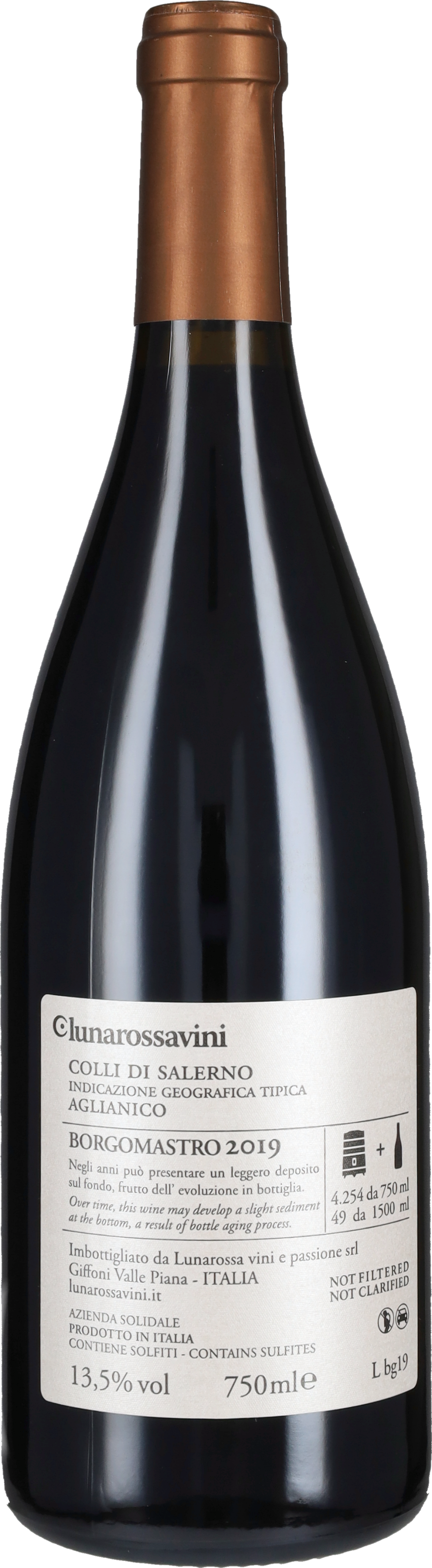
Aglianico 'Borgomastro' Lunarossa 2019The Aglianico "Borgomastro" Lunarossa is a red wine crafted in an artisanal style, vinified with a long maceration on the skins starting from a rigorous selection of the best Aglianico grapes from the hilly area of the Monti Piacentini. An absolutely substantial label, with precise aromas and flavors, which confirms the small winery's vocation to combine tradition with the desire to experiment, enhancing one of the most important native grape varieties of the region. The "Borgomastro" Lunarossa is a pure Aglianico, originating from vines about 30 years old. We find ourselves in soils characterized by a clayey and calcareous subsoil, facing east-west and located 250 meters above sea level. Among the rows, the yield per hectare does not exceed 60 quintals, and practices of organic farming are followed, respectful of the environment and the nature surrounding the vineyards. After gently pressing the grapes, the obtained must ferments in stainless steel containers, remaining in contact with the skins for two weeks.The final maturation phase lasts a total of 26 months in chestnut wood barrels, and before being released on the market, the "Borgomastro" ages for another 16 months directly in glass. The "Borgomastro" Aglianico from the Lunarossa winery presents itself visually with a garnet red color. The nose opens up to aromatic and wild herbs, enriched by fruity touches and more Mediterranean hints, while on the finish, spicier notes emerge. On the palate, it has excellent body, with a structured sip that relies on a beautiful tannic imprint, from which a fruity taste emerges. It closes with a finish that has excellent persistence. A perfect label to be enjoyed with meat menus, especially with roasted or stewed second courses.29,00 £*Shipping: 48,00 £Secure redirect to the provider
-
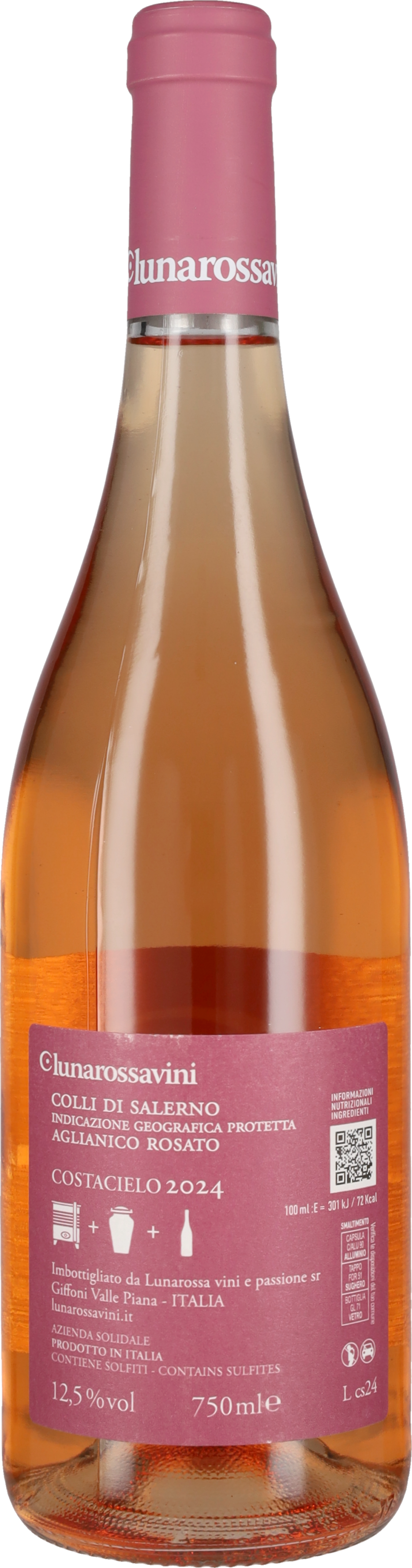
Costacielo Rosato Lunarossa 2024The "Costacielo" Rosato from Cantina Lunarossa is a Campanian wine produced in the Salerno area, near the Monti Picentini, a terroir that has proven to be very suitable for quality viticulture in recent decades. Rosés have historically been part of the tradition of our south, and a small and innovative reality like Lunarossa offers us an interesting wine aged in amphora. The bouquet is rich and intense, with aromas that mainly recall ripe cherry and the more fragrant notes of pomegranate juice. The taste is well-structured, juicy, and crisp, with a fresh finish that leans towards savory and mineral sensations. The Rosato "Costacielo" is born in the inland of Salerno, in the hilly area between the Picentino river and the sea. The warm Mediterranean climate is tempered by the gentle breezes of the Tyrrhenian Sea, creating ideal conditions for ripening grapes with particularly intense aromatic profiles. The Aglianico vines are cultivated in the Giffoni Val di Piana area, on alluvial soils rich in pebbles, sands, clays, and limestone.After the harvest, a soft pressing of the grapes is carried out, with brief contact with the skins. The free-run must is started on alcoholic fermentation in temperature-controlled steel tanks. The subsequent aging takes place in amphora, where it rests for at least six months in an inert material, which does not impart any scent to the wine, but allows a minimal level of micro-oxygenation, contributing to the aromatic evolution of the rosé towards greater maturity and expressive complexity. “Costacielo” is a rosé made from the Aglianico grape by Cantina Lunarossa. A classic grape of the area, present for centuries in Campania, which expresses itself very well in the territory of the Colli Picentini. The choice of aging in amphora recalls the oldest Georgian traditions, but also aims to preserve the most authentic aromas of Aglianico, with a maturation that rounds off its edges a bit. In the glass, it has a rather intense pink color, almost cerasuolo. On the nose, it opens with notes of cherry, wild strawberries, small red berry fruits, and pomegranate.and pomegranate. On the palate, it has good body, rich and mature aromas, supported by a light tannic nuance and balanced freshness. The finish is harmonious, with savory and mineral notes.15,00 £*Shipping: 48,00 £Secure redirect to the provider
-
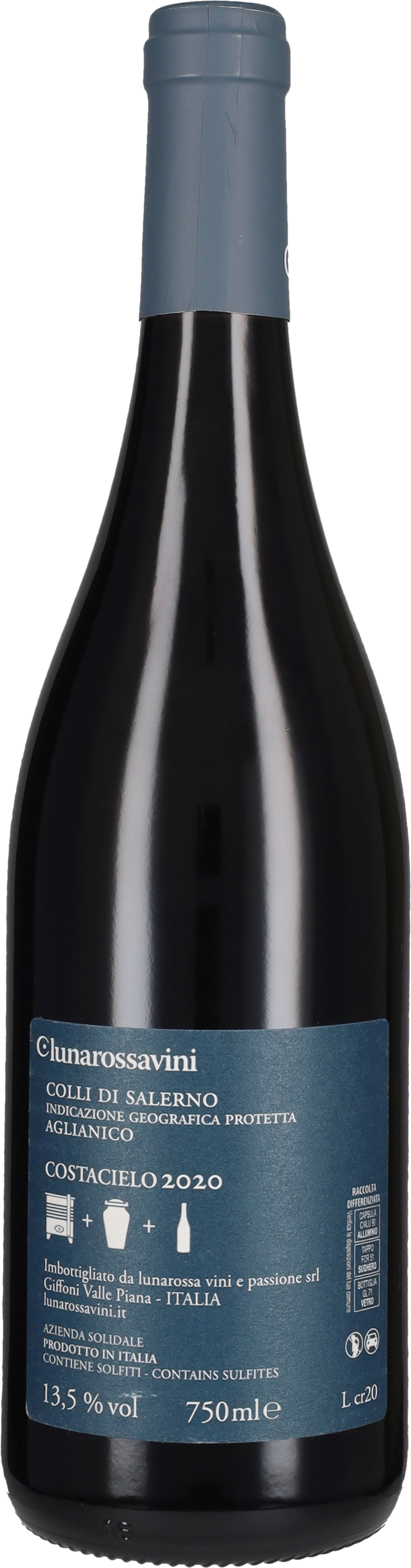
Costacielo Rosso Lunarossa 2021The Costacielo Rosso by Lunarossa is the photograph of the reflections that embrace the Salerno coastline at sunset. Sun and sea chase each other on the beautiful cliff that runs steeply along the Campania territory, forming long and intense reddish shadows that take your breath away. The blue of the sea and its beneficial influence are reflected in the 20-year-old Aglianico and Piedirosso vineyards, located at the foot of the Picentini mountains and overlooking the Gulf of Salerno, situated between 180 and 250 meters above sea level on clay and limestone soils. The vine exposure is East/West and the vineyard work aims to be as respectful as possible; not by chance, the winery follows the principles of organic farming. The Costacielo Rosso is obtained from the fermentation in steel, at controlled temperature, of the two grape varieties that make up its profile. The aging involves a stay of the wine for several months in terracotta amphorae, followed by an additional period of rest in bottle in specific rooms of the winery. The Costacielo Rosso is ruby red to the eye. On the nose, it shows fresh youth, with vegetal notes, almost ripe red fruits from the underbrush, and a spicy texture with sensations that recall the hay that whitens the fields under the summer sun. On the palate, it is pleasant, balanced, round and radiates drinkability with its velvety tannin. A wine that pulses with great pleasure and is capable of warming the soul.18,00 £*Shipping: 48,00 £Secure redirect to the provider

-
What are culinary perversions?
Culinary perversions refer to unconventional or extreme practices in the world of food and cooking. This can include unusual flavor combinations, extreme cooking techniques, or the use of non-traditional ingredients. Culinary perversions often push the boundaries of what is considered normal or acceptable in the culinary world, and can be seen as a form of experimentation or artistic expression. However, they can also be controversial and polarizing, challenging traditional notions of taste and culinary norms. **
-
What do believers think of the Epicurean paradox?
Believers typically reject the Epicurean paradox, which questions the existence of a benevolent and all-powerful God in the face of evil and suffering in the world. They may argue that God's ways are beyond human understanding, and that suffering serves a greater purpose in the divine plan. Believers often find comfort in their faith, trusting that God is ultimately just and loving, even in the midst of difficult circumstances. **
-
Is a culinary training worthwhile?
Yes, culinary training can be worthwhile for individuals who are passionate about pursuing a career in the culinary arts. It provides a strong foundation of knowledge and skills that can help aspiring chefs succeed in the competitive industry. Additionally, culinary training often includes hands-on experience and networking opportunities that can be valuable for career advancement. However, it is important for individuals to carefully consider their career goals and the cost of culinary training before making a decision. **
-
What is a culinary highlight?
A culinary highlight is a standout dish, meal, or dining experience that is particularly memorable and enjoyable. It could be a unique and delicious dish that stands out from the rest, a meal that is expertly prepared and beautifully presented, or a dining experience that is exceptional in terms of service, ambiance, and overall enjoyment. Culinary highlights can be found in a variety of settings, from fine dining restaurants to street food vendors, and they often leave a lasting impression on those who experience them. **

Can cats die from eating broccoli or similar delicacies?
Cats can eat broccoli in small amounts without any harm, but it is not a natural part of their diet. However, if a cat were to consume a large amount of broccoli or similar vegetables, it could potentially lead to gastrointestinal upset or even a blockage in their digestive system. Additionally, some cats may have an adverse reaction to certain vegetables, so it's best to consult with a veterinarian before introducing any new foods into a cat's diet. Overall, while it is unlikely for a cat to die from eating broccoli or similar delicacies, it's important to monitor their intake and ensure they are not consuming large quantities of unfamiliar foods. **
What do the believers think of the Epicurean paradox?
Believers generally reject the Epicurean paradox, which questions the existence of a benevolent and all-powerful God in the face of evil and suffering in the world. They believe that God's ways are beyond human understanding and that suffering serves a greater purpose in the divine plan. They may also argue that free will and the existence of evil are necessary for humans to have the ability to choose good and to grow spiritually. Ultimately, believers trust in the goodness and wisdom of God, even in the midst of suffering and evil. **
Top-Angebote
Products related to Fuorilinea-Lunarossa:
-
'Fuorilinea' LunarossaThe Campania IGT 'Fuorilinea' represents a bold experiment and intriguing innovation by the Lunarossa winery, located in the picturesque Monti Picentini in the province of Salerno. This Orange Wine, crafted from Moscato and Fiano grapes, features a truly unique and personal label, showcasing drawings created by local kindergarten children and changing from bottle to bottle. Led by Mario Mazzitelli and supported by winemaker Fortunato Sebastiano, Lunarossa winery embraces tradition while also looking towards innovation, exploring new winemaking techniques and even experimenting with international grape varieties. The 'Fuorilinea' by Lunarossa is the result of a winemaking process that begins with an extended maceration on the skins of white berries. The winery adopts a tradition-respecting approach inspired by Georgian winemaking, with fermentation taking place in amphorae and spontaneous fermentation supported by indigenous yeasts, thus preserving the authenticity and complexity of the terroir. The maturation journey of Fuorilinea Lunarossa is equally intriguing. After this initial phase, the wine undergoes a nuanced aging process that extends for 24 months. This process is balanced, with 50% of the wine resting in barrels, 25% in amphorae, and the remaining 25% in glazed cement. The combination of these different aging methods contributes to shaping the unique personality of Fuorilinea, providing it with deep complexity, elegance, and structure. Fuorilinea by Lunarossa presents itself in the glass with an intense orange-yellow color, revealing deep aromas of peach, figs, and spicy hints on the nose, enriched by elderflower and jasmine. On the palate, the pleasing density of the body harmoniously merges with lively acidity, culminating in an extraordinarily long finish. This structured wine pairs magnificently with well-structured seafood appetizers but is equally capable of complementing main dishes such as grilled fish. In each bottle of Fuorilinea Orange Wine, one can savor the passion, enthusiasm, and creativity of Lunarossa, making every sip a journey into the heart of the Colli Picentini.28,00 £*Shipping: 48,00 £Secure redirect to the provider
-
Quartara Lunarossa 2020vintages, from 60 to 90 days: the skins of the grapes progressively release color and aromatic substances and the wine is enriched in structure also thanks to contact with the fine lees. Once this process is completed, the wine rests in oak barrels for about a year and is bottled without filtration and without clarification. The Quartara Lunarossa presents itself as an intense and complex white wine with a deep golden yellow color, slightly opaque. Its bouquet is rich and broad and recalls candied fruit, honey, ginger, spices, anise, and fennel. On the palate, it reveals a full and voluminous sip, endowed with a fresh and mineral personality, which extends towards a persistent and vanilla finish. We are talking about a wine with a good aging potential, already in great shape, but we are sure that over time it can reach peaks of great excellence. Modernity and ancient tradition pulse in unison at the heart of Quartara.vintages, from 60 to 90 days: the skins of the grapes progressively release color and aromatic substances and the wine is enriched in structure also thanks to contact with the fine lees. Once this process is completed, the wine rests in oak barrels for about a year and is bottled without filtration and without clarification. The Quartara Lunarossa presents itself as an intense and complex white wine with a deep golden yellow color, slightly opaque. Its bouquet is rich and broad and recalls candied fruit, honey, ginger, spices, anise, and fennel. On the palate, it reveals a full and voluminous sip, endowed with a fresh and mineral personality, which extends towards a persistent and vanilla finish. We are talking about a wine with a good aging potential, already in great shape, but we are sure that over time it can reach peaks of great excellence. Modernity and ancient tradition pulse in unison at the heart of Quartara.29,00 £*Shipping: 48,00 £Secure redirect to the provider
-
Quartara Lunarossa 2021Quartara is a brilliant expression of Fiano vinified in amphora with extended skin contact: a great interpretation of the Monti Picentini terroir in the Salerno area, and a flagship of the Lunarossa winery. It owes its name to the particular type of amphora used, called 'quartara': terracotta jars with ancient rural origins, once widespread in southern Italy for wine preservation and abandoned for years in cellars. This is a kind of successful experiment, revived from the past as an alternative to cold steel containers and modern wooden barrels. Thus, this clear and genuine white is born, with an unaltered look, capable of revealing the most sincere soul of the Salerno territory. For the production of Quartara, small quantities of Santa Sofia grapes are also used, a white grape variety very similar to Fiano and now forgotten, cultivated in Cilento until the 19th century. The Fiano and Santa Sofia grapes are destemmed and placed with the skins in 250-liter quartara, where fermentation occurs spontaneously. This fermentation and maceration process can last, depending on the vintage, from 60 to 90 days: the grape skins gradually release color and aromatic substances, and the wine gains structure also thanks to contact with the fine lees. Once this process is completed, the wine rests in oak barrels for about a year and is bottled without filtration and clarification. Thus, Quartara Lunarossa presents itself as an intense and complex white wine with an intense golden yellow color, slightly opaque. Its bouquet is rich and broad, recalling candied fruit, honey, ginger, spices, anise, and fennel. On the palate, it reveals a full and voluminous sip, endowed with a fresh and mineral personality, leading to a persistent and vanilla finish. We are talking about a wine with a good aging potential, already in great shape, but we are confident that over time it can reach peaks of great excellence. The modernity and the ancient tradition pulse in unison at the heart of the Quartara.33,00 £*Shipping: 48,00 £Secure redirect to the provider
-
Aglianico 'Borgomastro' Lunarossa 2019The Aglianico "Borgomastro" Lunarossa is a red wine crafted in an artisanal style, vinified with a long maceration on the skins starting from a rigorous selection of the best Aglianico grapes from the hilly area of the Monti Piacentini. An absolutely substantial label, with precise aromas and flavors, which confirms the small winery's vocation to combine tradition with the desire to experiment, enhancing one of the most important native grape varieties of the region. The "Borgomastro" Lunarossa is a pure Aglianico, originating from vines about 30 years old. We find ourselves in soils characterized by a clayey and calcareous subsoil, facing east-west and located 250 meters above sea level. Among the rows, the yield per hectare does not exceed 60 quintals, and practices of organic farming are followed, respectful of the environment and the nature surrounding the vineyards. After gently pressing the grapes, the obtained must ferments in stainless steel containers, remaining in contact with the skins for two weeks.The final maturation phase lasts a total of 26 months in chestnut wood barrels, and before being released on the market, the "Borgomastro" ages for another 16 months directly in glass. The "Borgomastro" Aglianico from the Lunarossa winery presents itself visually with a garnet red color. The nose opens up to aromatic and wild herbs, enriched by fruity touches and more Mediterranean hints, while on the finish, spicier notes emerge. On the palate, it has excellent body, with a structured sip that relies on a beautiful tannic imprint, from which a fruity taste emerges. It closes with a finish that has excellent persistence. A perfect label to be enjoyed with meat menus, especially with roasted or stewed second courses.29,00 £*Shipping: 48,00 £Secure redirect to the provider
-
How should one behave in a fine dining restaurant?
In a fine dining restaurant, one should behave with proper etiquette and manners. This includes dressing appropriately, being polite and respectful to the staff, and using proper table manners. It is important to be mindful of noise levels and to avoid using electronic devices at the table. Additionally, one should be open to trying new foods and flavors, and be willing to engage in conversation with dining companions. Overall, the key is to be courteous, respectful, and open-minded while enjoying the dining experience. **
-
What is the address for a fine dining restaurant in Zurich?
One of the fine dining restaurants in Zurich is called "The Restaurant." It is located at Sihlstrasse 12, 8001 Zurich, Switzerland. The restaurant offers a luxurious dining experience with a focus on modern European cuisine. Reservations are recommended due to the restaurant's popularity. **
-
What are culinary perversions?
Culinary perversions refer to unconventional or extreme practices in the world of food and cooking. This can include unusual flavor combinations, extreme cooking techniques, or the use of non-traditional ingredients. Culinary perversions often push the boundaries of what is considered normal or acceptable in the culinary world, and can be seen as a form of experimentation or artistic expression. However, they can also be controversial and polarizing, challenging traditional notions of taste and culinary norms. **
-
What do believers think of the Epicurean paradox?
Believers typically reject the Epicurean paradox, which questions the existence of a benevolent and all-powerful God in the face of evil and suffering in the world. They may argue that God's ways are beyond human understanding, and that suffering serves a greater purpose in the divine plan. Believers often find comfort in their faith, trusting that God is ultimately just and loving, even in the midst of difficult circumstances. **
Similar search terms for Fuorilinea-Lunarossa
-
Costacielo Rosato Lunarossa 2024The "Costacielo" Rosato from Cantina Lunarossa is a Campanian wine produced in the Salerno area, near the Monti Picentini, a terroir that has proven to be very suitable for quality viticulture in recent decades. Rosés have historically been part of the tradition of our south, and a small and innovative reality like Lunarossa offers us an interesting wine aged in amphora. The bouquet is rich and intense, with aromas that mainly recall ripe cherry and the more fragrant notes of pomegranate juice. The taste is well-structured, juicy, and crisp, with a fresh finish that leans towards savory and mineral sensations. The Rosato "Costacielo" is born in the inland of Salerno, in the hilly area between the Picentino river and the sea. The warm Mediterranean climate is tempered by the gentle breezes of the Tyrrhenian Sea, creating ideal conditions for ripening grapes with particularly intense aromatic profiles. The Aglianico vines are cultivated in the Giffoni Val di Piana area, on alluvial soils rich in pebbles, sands, clays, and limestone.After the harvest, a soft pressing of the grapes is carried out, with brief contact with the skins. The free-run must is started on alcoholic fermentation in temperature-controlled steel tanks. The subsequent aging takes place in amphora, where it rests for at least six months in an inert material, which does not impart any scent to the wine, but allows a minimal level of micro-oxygenation, contributing to the aromatic evolution of the rosé towards greater maturity and expressive complexity. “Costacielo” is a rosé made from the Aglianico grape by Cantina Lunarossa. A classic grape of the area, present for centuries in Campania, which expresses itself very well in the territory of the Colli Picentini. The choice of aging in amphora recalls the oldest Georgian traditions, but also aims to preserve the most authentic aromas of Aglianico, with a maturation that rounds off its edges a bit. In the glass, it has a rather intense pink color, almost cerasuolo. On the nose, it opens with notes of cherry, wild strawberries, small red berry fruits, and pomegranate.and pomegranate. On the palate, it has good body, rich and mature aromas, supported by a light tannic nuance and balanced freshness. The finish is harmonious, with savory and mineral notes.15,00 £*Shipping: 48,00 £Secure redirect to the provider
-
Costacielo Rosso Lunarossa 2021The Costacielo Rosso by Lunarossa is the photograph of the reflections that embrace the Salerno coastline at sunset. Sun and sea chase each other on the beautiful cliff that runs steeply along the Campania territory, forming long and intense reddish shadows that take your breath away. The blue of the sea and its beneficial influence are reflected in the 20-year-old Aglianico and Piedirosso vineyards, located at the foot of the Picentini mountains and overlooking the Gulf of Salerno, situated between 180 and 250 meters above sea level on clay and limestone soils. The vine exposure is East/West and the vineyard work aims to be as respectful as possible; not by chance, the winery follows the principles of organic farming. The Costacielo Rosso is obtained from the fermentation in steel, at controlled temperature, of the two grape varieties that make up its profile. The aging involves a stay of the wine for several months in terracotta amphorae, followed by an additional period of rest in bottle in specific rooms of the winery. The Costacielo Rosso is ruby red to the eye. On the nose, it shows fresh youth, with vegetal notes, almost ripe red fruits from the underbrush, and a spicy texture with sensations that recall the hay that whitens the fields under the summer sun. On the palate, it is pleasant, balanced, round and radiates drinkability with its velvety tannin. A wine that pulses with great pleasure and is capable of warming the soul.18,00 £*Shipping: 48,00 £Secure redirect to the provider
-
Costacielo Bianco Lunarossa 2024The Costacielo Bianco by Lunarossa is a wine that encapsulates the soul of the beautiful Salerno coastline and the sky that reflects in its sea. The harmony generated by the aging of the local white grape, Fiano, in ancestral clay containers, local amphorae rediscovered to nurture the identity of this wine according to the historical tradition of the past, is fascinating. The vines of 20 years of age from which the grapes for the Costacielo Bianco are sourced are located on clay-limestone soils, at an altitude of 180-250 meters above sea level, excellently exposed to East/West and cultivated organically. The entire area is protected behind the Picentine and Irpinian peaks and is greatly influenced by the sea breezes coming from the Gulf of Salerno. The cellar work involves fermentation of the grapes in steel tanks at controlled temperature. The aging of the grapes requires a period of at least 6 months in terracotta amphora. The Costacielo Bianco is pale golden yellow in appearance. Intriguing on the nose with aromatic sensations that fade from hints of exotic yellow fruit to honey, hazelnut, dried fruit, and yellow flowers. On the palate, marine notes are perceived. With a tasty freshness and sapidity, and a beautiful verticality noticeable during drinking and a persistent finish. A decidedly surprising and complex wine.18,00 £*Shipping: 48,00 £Secure redirect to the provider
-
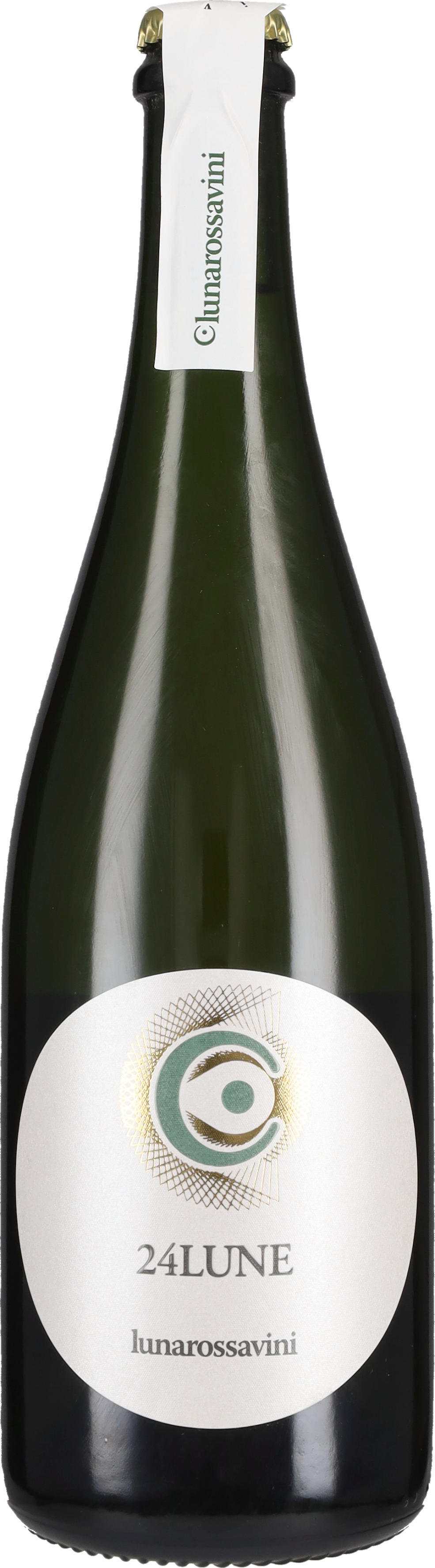
Rifermentato in bottiglia '24 Lune' LunarossaThe Bottle-Refermented '24 Lune,' produced by Lunarossa winery, represents an attempt to encapsulate in a bottle all the aromas and beauties of a land rich in millenary traditions. Located in a captivating territory, influenced by the majestic Picentini mountains and the sea breeze from the Gulf of Salerno, Lunarossa stands out as a winemaking reality that embraces modernity within a traditional context. This wine, obtained from Fiano grapes, embodies the essence of the place and presents itself as a unique and characteristic work. The production process of Lunarossa's Bottle-Refermented '24 Lune' follows a traditional white vinification of Fiano grapes, followed by a 12-month refinement in amphora. Subsequently, the wine is bottled with the must from the next harvest and yeast, initiating a second fermentation in the bottle that also lasts for 12 months. This technique, combining controlled-temperature steel fermentation, amphora refinement, and bottle aging, gives the wine a unique complexity, emphasizing the blend of tradition and innovation that characterizes the Lunarossa winery. '24 Lune' Bottle-Refermented by Lunarossa presents itself in the glass with a straw-yellow color and golden reflections, manifesting intense aromas of ripe yellow pulpy fruit, apricot, and tangerine on the nose. In the mouth, the sip is full-bodied, with a note of hazelnut that harmoniously merges with the savory finish. This bottle-fermented wine thus emerges as a versatile option, capable of enriching every convivial moment with its uniqueness and sensory complexity.19,00 £*Shipping: 48,00 £Secure redirect to the provider
-
Is a culinary training worthwhile?
Yes, culinary training can be worthwhile for individuals who are passionate about pursuing a career in the culinary arts. It provides a strong foundation of knowledge and skills that can help aspiring chefs succeed in the competitive industry. Additionally, culinary training often includes hands-on experience and networking opportunities that can be valuable for career advancement. However, it is important for individuals to carefully consider their career goals and the cost of culinary training before making a decision. **
-
What is a culinary highlight?
A culinary highlight is a standout dish, meal, or dining experience that is particularly memorable and enjoyable. It could be a unique and delicious dish that stands out from the rest, a meal that is expertly prepared and beautifully presented, or a dining experience that is exceptional in terms of service, ambiance, and overall enjoyment. Culinary highlights can be found in a variety of settings, from fine dining restaurants to street food vendors, and they often leave a lasting impression on those who experience them. **
-
Can cats die from eating broccoli or similar delicacies?
Cats can eat broccoli in small amounts without any harm, but it is not a natural part of their diet. However, if a cat were to consume a large amount of broccoli or similar vegetables, it could potentially lead to gastrointestinal upset or even a blockage in their digestive system. Additionally, some cats may have an adverse reaction to certain vegetables, so it's best to consult with a veterinarian before introducing any new foods into a cat's diet. Overall, while it is unlikely for a cat to die from eating broccoli or similar delicacies, it's important to monitor their intake and ensure they are not consuming large quantities of unfamiliar foods. **
-
What do the believers think of the Epicurean paradox?
Believers generally reject the Epicurean paradox, which questions the existence of a benevolent and all-powerful God in the face of evil and suffering in the world. They believe that God's ways are beyond human understanding and that suffering serves a greater purpose in the divine plan. They may also argue that free will and the existence of evil are necessary for humans to have the ability to choose good and to grow spiritually. Ultimately, believers trust in the goodness and wisdom of God, even in the midst of suffering and evil. **
* All prices are inclusive of VAT and, if applicable, plus shipping costs. The offer information is based on the details provided by the respective shop and is updated through automated processes. Real-time updates do not occur, so deviations can occur in individual cases. ** Note: Parts of this content were created by AI.